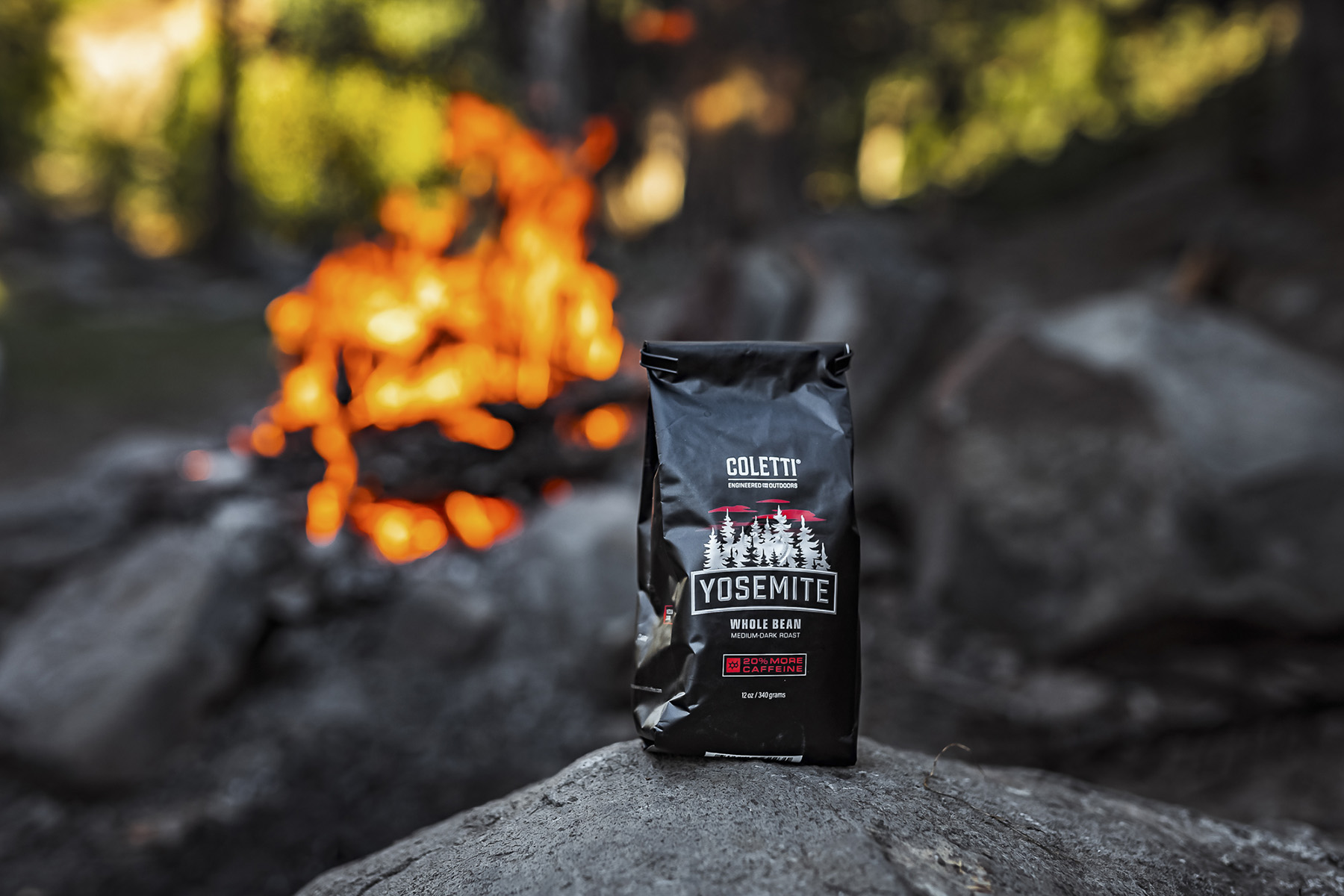
A black bag of coffee sitting on a granite boulder. Campfire blurred orange and gold behind it. Trees catching the last light overhead. The product is sharp. The environment is soft. And the person scrolling past this image on their phone doesn’t think “that’s a nice bag of coffee.” They think “I want to be wherever that is, drinking whatever that is.” That’s the difference between product photography and lifestyle product photography. One shows the item. The other shows the life.
I shot this image for Coletti Coffee, an outdoor-focused brand that sells percolators, camp gear, and whole bean coffee for people who make their morning cup over a fire instead of a Keurig. Their packaging is matte black with bold white type. Their brand story is built around national parks, campfires, and mornings that start before sunrise. Photographing their products on a white background would have been technically clean and strategically wrong. The white background shows the bag. The campfire shows the customer’s Saturday morning.
If your brand sells a feeling attached to a place, the product needs to live in that place for the photography to work.
The Environment Is Part of the Product Story
Outdoor brands don’t sell products in isolation. They sell experiences that happen to include a product. A camp coffee brand sells the morning ritual around a fire. A hiking gear company sells the view from the ridge. A trail snack brand sells the break at the summit where you finally sit down and eat something. The product is present in all of these moments, but it’s not the main character. The moment is.
Lifestyle product photography for outdoor brands works because it puts the product inside the moment the customer is already imagining. The granite boulder under the Coletti bag isn’t a random surface. It’s the spot where you’d actually set your coffee down while you stoke the fire. The campfire isn’t a backdrop. It’s the reason you brought the percolator in the first place. Every element in the frame reinforces why this product exists.
This is where product photography background ideas get interesting for outdoor brands. The studio mindset says “find a clean surface that doesn’t distract.” The outdoor brand mindset says “find the surface that tells the story.” Rough-cut wood, river rock, packed trail dirt, a tailgate. Each one communicates a different version of the outdoor life, and the right one depends entirely on who your customer is and where they picture themselves using your product.
Dark Packaging in Natural Light Is Harder Than It Looks
Matte black packaging absorbs light. That’s the fundamental technical problem. In a studio, you control every light source and can sculpt highlights onto dark surfaces with precision. Outdoors, you’re working with whatever the sun and the environment give you. A black bag on a dark rock next to a campfire could easily become a shadow with a logo floating in it.
The product photography tip that matters most for dark outdoor products is timing. Golden hour provides warm, directional light that rakes across surfaces and creates natural highlights on packaging without washing out the color. The Coletti shoot happened in late afternoon when the light was low enough to warm the scene but still strong enough to separate the black bag from the dark granite underneath. Thirty minutes earlier, the light would have been too flat. Thirty minutes later, the bag would have disappeared into the shadows.
Reflective surfaces add another layer. The stainless steel percolator in the Coletti lineup is a mirror sitting on a rock next to a fire. Every surface reflects the environment: orange firelight, green canopy, gray stone. Managing those reflections outdoors means controlling the angle between the product, the light source, and the camera. You can’t flag off the sun with a studio V-flat when you’re standing in a national forest. You reposition the product, change your camera angle, and wait for the light to shift. The technical constraints are real, but they also produce images with a warmth and authenticity that studio lighting can’t replicate.
The Product Must Be the Subject, Not a Prop in a Nature Photo
The most common failure in outdoor product photography is creating a beautiful nature image where the product happens to appear. The campfire is stunning. The mountains are dramatic. The product is a small, unreadable object in the lower third of the frame. That’s a travel photo with a product cameo, not a product photo with environmental context.
Lifestyle product photography requires a visual hierarchy where the product reads first. In the Coletti campfire shots, the bag is positioned on the nearest surface to the camera, sharp and centered in the frame. The fire is behind it, intentionally soft, providing context without competing for attention. The eye goes to the product, then to the environment. That sequence matters because the purpose of the image is to sell the product. The environment supports the sale. It doesn’t replace the selling.
Depth of field is the primary tool for managing this hierarchy outdoors. A wide aperture keeps the product sharp while the background falls into a soft bokeh that communicates the setting without documenting it. The viewer’s brain registers “campfire, outdoors, adventure” from the blurred warm tones without needing every log and flame in focus. That separation between sharp product and soft context is what makes the image work as both lifestyle content and commercial photography.
Framing and scale matter too. The product should occupy enough of the frame that the viewer can read the label, understand the size, and see the packaging details. If you have to zoom in to identify what the product is, the shot is composed for the environment, not for the brand. Pull the camera closer, open the aperture wider, and let the environment do its work from the edges and the background.
Planning an Outdoor Product Shoot That Actually Works
Studio shoots run on control. Outdoor shoots run on preparation and flexibility. The light changes by the minute. Weather can shift a plan entirely. The “perfect spot” from your scout might be occupied by another group or covered in fallen branches. Every outdoor brand photography session needs a plan B for location, timing, and setup.
Scout the location before the shoot day. Identify three to five specific spots with different backgrounds and different light angles. Know what time golden hour starts and work backward from there to build the schedule. If the shoot depends on campfire as a background element, the fire needs to be burning and established well before the first frame. A freshly lit fire looks like a freshly lit fire. An established one looks like warmth.
Bring more product than you think you need. Packaging gets dirty, wet, or scuffed when you’re placing it on real outdoor surfaces. Coletti sent multiple units of each product so I could swap in clean packaging if a bag picked up dust or a percolator caught a fingerprint from repositioning. In a studio, a quick wipe fixes it. Outdoors, moisture and debris are constant. Having backup product on set prevents losing shots to packaging that looked great in person but shows every smudge on camera.
Build the shot list around the marketing need, then adapt it to the environment on the day. The plan says “product on rock surface with fire background.” The location gives you a granite slab that catches the light better than expected at a slightly different angle. Adapt. The plan is the framework. The environment provides opportunities you couldn’t predict from a mood board.
Your Product Belongs Where Your Customer Pictures It
Lifestyle product photography for outdoor brands works when the image puts the viewer inside a moment they already want. The coffee by the campfire. The gear at the trailhead. The product in the exact context where the customer imagines using it. Studio shots show what you sell. Lifestyle shots show why someone would buy it. If your brand is built around a place, an activity, or a feeling, the product photography needs to live there too. DM me “lifestyle product photography” if your outdoor brand needs images that sell the experience, not just the label.